
Daily Drop (1098)
07-31-25

Thursday, Jul 31, 2025 // (IG): BB // GITHUB // SN R&D
AI Infrastructure Surge Risks Bubble as $3 Trillion Data Center Boom Outpaces Demand
Bottom Line Up Front (BLUF): Morgan Stanley projects a $3 trillion global buildout of data centers by 2028 to support generative AI (GenAI) growth. Only half are expected to be funded by hyperscaler cash flows. The rest may rely on private credit, securitized loans, and institutional investors. Despite optimism around GenAI monetization, concerns about overcapacity, power constraints, and long-term ROI are rising.
Analyst Comments: The assumption that AI will scale to $1 trillion in annual revenue by 2028 underpins the capital strategy, but similar past tech cycles show how fragile those projections can be. Risks include technological obsolescence, GPU depreciation, energy supply bottlenecks, and monetization lag. As hyperscalers fund only the most promising facilities, private and securitized investors could be left holding underperforming assets.
FROM THE MEDIA: Morgan Stanley’s bullish analysis estimates a sixfold increase in global data center capacity by 2030, requiring $3 trillion in capex—$1.6 trillion for AI chips and $1.3 trillion for real estate and fit-outs. While hyperscalers like Google, Amazon, and Microsoft have ramped up AI infrastructure spending, projected monetization timelines don’t align with immediate funding needs, prompting a call for private capital and asset-backed securities. The report also acknowledges that over half of the new buildout will be in the U.S., which lacks the power infrastructure to support it. Critics warn that demand projections for GenAI are speculative and that investments today could resemble the stranded assets of the telecom crash if expectations falter.
READ THE STORY: FT
Researchers Exploit Zero-Day Flaws in Retired Netgear and BitDefender Devices
Bottom Line Up Front (BLUF): Security researchers from Trail of Bits successfully demonstrated critical zero-day exploits in two discontinued consumer devices—the Netgear WGR614v9 router and BitDefender Box V1—during DistrictCon’s 2025 Junkyard competition. The vulnerabilities enabled full remote system compromise, revealing the persistent risk posed by end-of-life (EOL) IoT devices that no longer receive security updates.
Analyst Comments: Despite their outdated status, these devices handle sensitive traffic, often behind firewalls or in semi-isolated networks. Using novel techniques like “bashsledding” and firmware downgrades to bypass protections underscores the creativity of today’s exploit developers. Manufacturers and consumers must take device lifecycle security more seriously, especially for hardware marketed as security solutions.
FROM THE MEDIA: During the inaugural DistrictCon Junkyard challenge in February 2025, researchers from Trail of Bits exploited critical flaws in two legacy network devices: the Netgear WGR614v9 router and BitDefender Box V1. The Netgear router was compromised via three UPnP-related bugs, enabling remote root access through a technique dubbed “bashsledding.” Meanwhile, the BitDefender Box—ironically designed as a security appliance—suffered from an unauthenticated firmware downgrade flaw, letting attackers revert to insecure versions and achieve persistent code execution. Both devices required hardware-level analysis, with the team leveraging UART interfaces and SPI flash dumping to reverse engineer the firmware. Their complete findings and exploit code have been released on GitHub, highlighting broader issues with the security of abandoned IoT products.
READ THE STORY: GBhackers
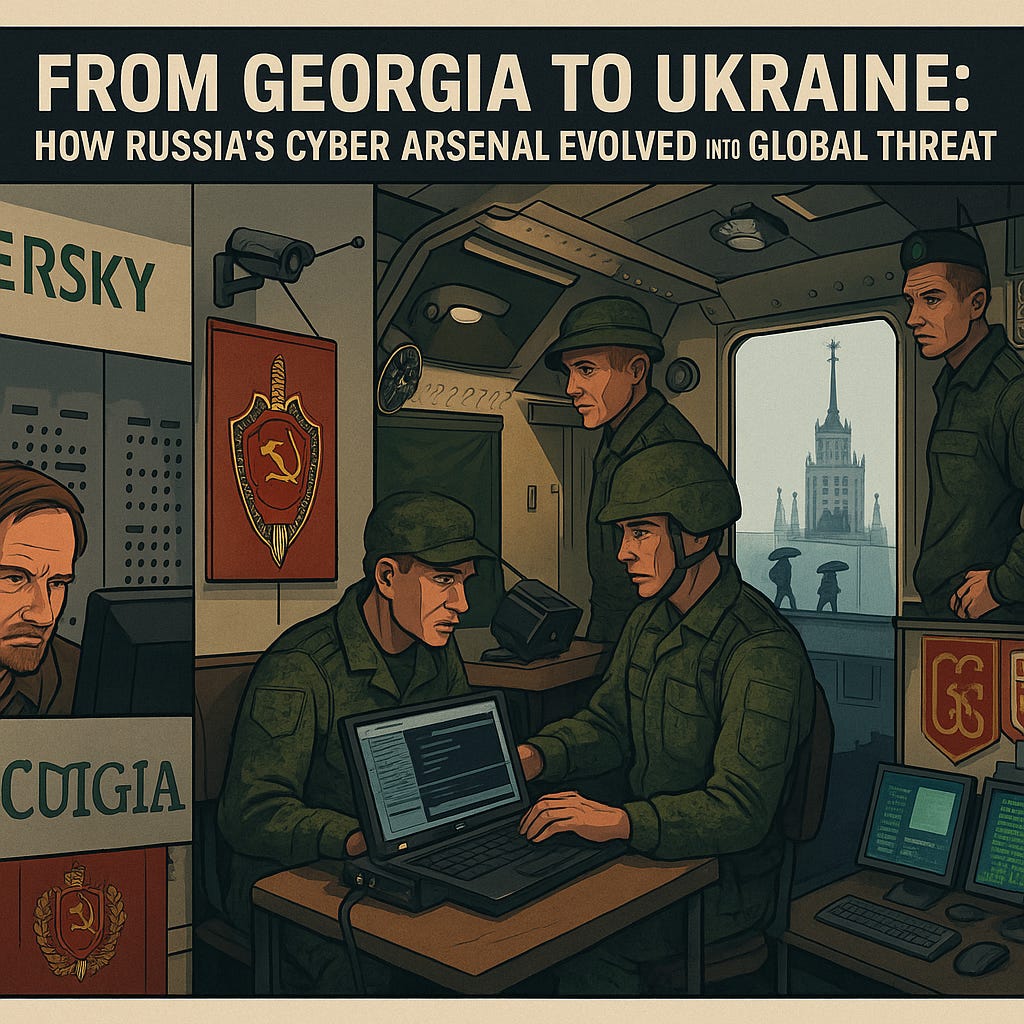
Russia’s Cyber Warfare Playbook: From Georgia to Ukraine and Beyond
Bottom Line Up Front (BLUF): Russia’s cyber capabilities have evolved dramatically from the crude DDoS and defacement attacks during the 2008 Georgia conflict to sophisticated, multi-vector operations in Ukraine. These cyber campaigns are now integral to Moscow’s hybrid warfare strategy, featuring destructive malware, false-flag operations, and disinformation campaigns that extend far beyond battlefield borders.
Analyst Comments: The long arc of Russia’s cyber aggression highlights a strategic commitment to integrating digital operations into conventional military campaigns. What began as experimental disruption in Georgia has matured into global-scale, state-sponsored cyberwarfare capable of targeting critical infrastructure and influencing public narratives. While cyberattacks have yet to yield decisive battlefield outcomes in Ukraine, their growing role in intelligence gathering, information warfare, and transnational influence is undeniable. Future conflicts involving Russia—or other cyber-enabled adversaries like China—will likely feature similar hybrid methods, making cyber resilience an essential component of national defense.
FROM THE MEDIA: These tactics expanded during the 2014 annexation of Crimea and reached a new level during the 2022 full-scale invasion of Ukraine. Operations included wiper malware (FoxBlade), disruption of satellite communications, and a coordinated attack on Ukraine’s energy grid. Microsoft and Google report increased espionage efforts targeting NATO-aligned countries and suppliers. Complementing these attacks are large-scale disinformation campaigns, including false-flag operations designed to obfuscate attribution. A 2019 Wired investigation documented how Russian groups like Turla hijacked Iranian cyber infrastructure to mask their identity, further complicating global threat intelligence efforts.
READ THE STORY: MWI
Chinese Companies Tied to Silk Typhoon Filed Patents for Advanced Cyber Espionage Tools
Bottom Line Up Front (BLUF): A new report by SentinelOne reveals that Chinese firms linked to the state-sponsored hacking group Silk Typhoon (aka Hafnium) have filed more than 15 patents for cyber espionage technologies. These patents offer rare insight into China's cyber contractor ecosystem, detailing capabilities in encrypted data collection, Apple device forensics, and router surveillance. The findings coincide with recent U.S. indictments of individuals tied to these firms for high-profile hacking campaigns.
Analyst Comments: Rather than operating in the shadows alone, groups like Silk Typhoon rely on a layered ecosystem of contractors, many of whom openly develop and patent sophisticated surveillance technologies. This blurs the line between private enterprise and state-backed espionage, making attribution more difficult and defense more complex. The presence of former indicted hackers in new corporate roles underscores the revolving-door nature of China’s cyber industrial complex, posing persistent risks for global infrastructure and supply chains.
FROM THE MEDIA: The firms—Shanghai Firetech, Shanghai Powerock, and Shanghai Siling Commerce—are said to operate under the authority of the Shanghai State Security Bureau, a regional arm of China’s Ministry of State Security (MSS). Several indicted hackers were employed at these companies, including Xu Zewei, Zhang Yu, and Yin Kecheng. The patents describe tools for encrypted endpoint surveillance, router access, and closed-access operations. Analysts suggest these tools may be used by multiple MSS offices, further complicating public attribution of cyber incidents.
READ THE STORY: THN
Maritime Cyber Threats Surge: Nation-State Hackers and Hacktivists Target Global Shipping Infrastructure
Bottom Line Up Front (BLUF): New research from Cyble highlights a significant rise in cyberattacks targeting maritime infrastructure worldwide, with over 100 incidents linked to state-sponsored actors and hacktivists. Tactics include GPS spoofing, AIS manipulation, and malware deployment on cargo ships, posing serious threats to global trade and navigational safety.
Analyst Comments: As digital systems become more integral to maritime operations, attackers shift from nuisance-level defacements to highly sophisticated intrusions that compromise vessel navigation, logistics, and communications. Without accelerated investment in segmentation, secure remote access, and attack surface monitoring, the global shipping industry risks cascading failures across critical infrastructure and supply chains.
FROM THE MEDIA: Pro-Palestinian hacktivists reportedly used AIS data to target Israeli-linked vessels, while Chinese APTs like Mustang Panda and APT41 breached shipping firms across Europe and Asia. Russian groups such as APT28 and Turla have attacked NATO maritime logistics, and Iran’s Crimson Sandstorm targeted Mediterranean transport sectors. Critical vulnerabilities—including CVE-2025-5777 in Citrix NetScaler and CVE-2025-52579 in Emerson ValveLink—have been flagged as high-risk for systems controlling ballast, fuel, and navigation. Cyble warns that spoofing and GPS interference in chokepoints like the Strait of Hormuz could escalate into physical maritime incidents. Their recommendations include USB bans in operational zones, unidirectional gateways, ECDIS segmentation, and transitioning to blockchain-based chart updates. The report concludes with urgent calls for compliance with IACS UR E26/E27 and the EU’s NIS2 Directive.
READ THE STORY: Industrial
ChatGPT’s New Spreadsheet Powers Signal Disruption for Excel Users and Office Roles
Bottom Line Up Front (BLUF): ChatGPT is rapidly evolving from a coding assistant into an autonomous spreadsheet user, capable of creating, populating, and manipulating Excel-like files without human input or Microsoft Office. New tools under development allow for spreadsheet and presentation generation entirely within the ChatGPT interface, potentially displacing traditional office software and clerical work.
Analyst Comments: This move marks a significant step toward agent-based automation of routine office tasks — and a profound shift in how knowledge work is performed. ChatGPT’s ability to functionally “use” spreadsheets like a human user redefines the boundary between AI assistance and direct job replacement. While businesses stand to benefit from productivity gains and cost savings, this acceleration also raises urgent questions around job displacement, digital upskilling, and software licensing economics. Microsoft may soon find its Excel monopoly eroded not by a direct competitor, but by AI-powered user platforms like ChatGPT.
FROM THE MEDIA: New features will allow users to create and edit spreadsheets and presentations without relying on Microsoft licenses. Reports from The Information, Business Standard, and Wired describe this as a significant shift in the office software landscape. A GitHub contributor, “Ameenha23,” highlights that ChatGPT-4 can automate Excel-based tasks, offer interactive support, and perform complex data operations with minimal user input. With tools set to arrive as early as September 2025, clerical roles that rely heavily on Excel may face rapid automation.
READ THE STORY: Forbes
China Eyes Lasers, Sabotage, and Satellite Tailgating to Counter Musk’s Starlink Network
Bottom Line Up Front (BLUF): Chinese military and government-backed researchers are developing a range of countermeasures against Elon Musk’s Starlink satellite constellation, which Beijing sees as a growing military and intelligence threat. Proposed tactics include satellite tailing, laser disruption, and supply chain sabotage, reflecting China’s broader concerns about U.S. space dominance.
Analyst Comments: The publication of dozens of research papers on neutralizing Starlink reveals a strategic escalation in China's military-cyber focus on space infrastructure. China's recognition of Starlink as a dual-use platform—serving both civilian and military interests—mirrors global anxieties over privatized space assets with geopolitical influence. These proposed countermeasures suggest China is moving toward a doctrine of preemptive disruption, including cyber-physical sabotage, raising concerns about satellite security and the potential for conflict escalation in orbit.
FROM THE MEDIA: Suggested methods range from space-based lasers and optical jamming to “stalker satellites” equipped with ion thrusters or corrosive payloads. Some papers proposed attacking Starlink's global supply chain by exploiting its vendor network’s cybersecurity weaknesses. The concern stems from Starlink’s battlefield use in Ukraine and its extensive collaboration with U.S. intelligence and defense agencies. With over 8,000 active satellites and a dominant share of the LEO market, Starlink has triggered a global satellite race and corresponding threat modeling by adversaries like China and Russia.
READ THE STORY: ABCNEWS
Silent Crow Hacktivists Breach Aeroflot in Major Anti-Russian Cyber Attack
Bottom Line Up Front (BLUF): Pro-Ukraine hacker group Silent Crow has claimed responsibility for a massive cyberattack on Russia’s national airline, Aeroflot, disrupting flight operations and compromising critical infrastructure. The hackers allege they infiltrated systems for over a year, stealing 20 terabytes of data and destroying 7,000 servers.
Analyst Comments: Silent Crow's collaboration with Belarusian group Cyber Partisans points to a growing alignment among anti-Kremlin cyber actors. While the group’s Telegram rhetoric and lack of ransom demands suggest ideological rather than financial motivation, the scale and timing raise questions about potential state backing. Russia’s digital defenses appear increasingly vulnerable as non-state actors adopt APT-style persistence and long-term operational planning.
FROM THE MEDIA: Aeroflot was forced to cancel dozens of flights on July 29, 2025, after its IT systems were rendered inoperable by a large-scale cyberattack. Silent Crow announced the operation on Telegram, stating they had destroyed internal infrastructure after a year-long infiltration. This follows their prior breaches of Rosreestr, Rostelecom, and Alfa Bank. Silent Crow has not issued ransom demands, instead framing their actions as part of a cyber resistance against Russia’s invasion of Ukraine and Belarusian authoritarianism. The Kremlin has acknowledged the breach as “worrying,” and Russia’s Prosecutor General has opened a criminal investigation.
READ THE STORY: Independent
Ukraine Conducts First Maritime FPV Drone Strike Against Russian Offshore Platform
Bottom Line Up Front (BLUF): Ukraine’s Defense Intelligence carried out a first-of-its-kind FPV drone strike launched from boats in the Black Sea, targeting a Russian-occupied gas platform. This operation marks a significant tactical innovation in Ukraine's drone warfare, showcasing expanding capabilities in maritime strike operations.
Analyst Comments: Ukraine’s ability to project drone power from maritime positions complicates Russian defense postures and exposes vulnerabilities in offshore infrastructure. As Russia continues to militarize civilian installations like gas rigs, these precision drone strikes may become a recurring threat vector, signaling a broader integration of naval and aerial UAV tactics. Future operations could push further into contested sea zones, forcing Russia to rethink maritime force protection.
FROM THE MEDIA: This operation marks the first documented instance of FPV drones deployed from maritime platforms. Ukrainian forces successfully neutralized Russian firing positions, disrupting enemy operations and gaining a tactical foothold in contested waters. The strike, captured on video, demonstrates Ukraine’s increasing proficiency in coordinating air-sea-electronic warfare for precision strikes, expanding its strategic footprint in the maritime domain.
READ THE STORY: Defense Express
North Korea’s TraderTraitor Subgroup Escalates Supply Chain and Cloud Attacks
Bottom Line Up Front (BLUF): TraderTraitor, a North Korean threat actor under the Lazarus Group, has intensified its targeting of cloud platforms and software supply chains in a series of high-impact attacks against cryptocurrency and DeFi firms. The group leverages phishing, poisoned developer tools, and compromised CI/CD environments to steal credentials, distribute malware, and siphon hundreds of millions in digital assets.
Analyst Comments: Its pivot from phishing campaigns to software supply chain poisoning highlights the growing risks to DevOps environments and cloud-native ecosystems. As attacks target CI/CD pipelines, SaaS integrations, and developer endpoints, security teams must rethink trust models and enforce tighter identity and access controls across cloud assets. Expect further intrusions as geopolitical pressure incentivizes North Korea to continue monetizing cybercrime.
FROM THE MEDIA: Once inside, it deploys malware such as MANUSCRYPT and RN Stealer to exfiltrate credentials and cloud keys. Notable incidents include the 2023 JumpCloud breach, which enabled lateral movement into customer environments, and the 2025 Bybit and DMM Bitcoin heists, resulting in losses exceeding $1.8 billion. TraderTraitor exploited poisoned Docker containers, unencrypted communication channels, and misconfigured IAM roles in both cases. Industry and law enforcement—including the FBI and Japan’s NPA—attribute these campaigns directly to North Korea’s cyber apparatus.
READ THE STORY: Cyber Press
Taiwan Builds Maritime Drone Army to Counter Growing Threat from China
Bottom Line Up Front (BLUF): Taiwan is accelerating its investment in homegrown drone technologies, including maritime and suicide drones, as part of a broader asymmetric defense strategy against a potential Chinese invasion. Despite technological capacity and political momentum, experts warn Taiwan’s production targets and operational planning still fall short of modern warfare demands.
Analyst Comments: Taipei’s pivot toward drones reflects lessons from Ukraine’s wartime innovation, but the gap between ambition and readiness is stark. While Taiwan excels at manufacturing, military drone strategy has suffered from underinvestment in deployment planning, anti-drone capabilities, and secure supply chains. Civil-military collaboration, battlefield testing, and geopolitical resilience—especially in the face of Chinese sanctions—will determine whether Taiwan can mature from drone builder to adequate drone power.
FROM THE MEDIA: These systems are key to Taipei’s “porcupine strategy” to deter Chinese amphibious assaults across the Taiwan Strait. Since launching its “Drone National Team” initiative in 2022, Taiwan has aimed to produce 15,000 dual-use drones monthly by 2028. However, only 700 military-grade UAVs have been ordered so far, far fewer than analysts deem necessary. The US has pledged drone shipments, but experts from the Jamestown Foundation and Ukraine’s Center for Army Studies argue Taiwan must drastically scale production, embrace battlefield simulation, and address its dependence on Chinese components. Industry leaders and legislators call for better funding, faster decision-making, and real-world battlefield feedback to refine Taiwan’s drone readiness before a potential PLA assault by 2027.
READ THE STORY: Aljazeera
Iran Blocks Citizens’ SIM Cards to Silence Dissent on Social Media
Bottom Line Up Front (BLUF): Iranian authorities are disabling mobile phone access without court orders to pressure citizens into deleting online criticism of the government, particularly over the Israel-Iran war. Security forces use this extrajudicial tactic to enforce political compliance, severely disrupting individuals' access to essential services and digital infrastructure.
Analyst Comments: This strategy marks a chilling evolution in authoritarian digital control. By turning SIM cards into levers of coercion, Iran bypasses courts and legal procedures to suppress speech. It’s a modern-day “digital exile” where political loyalty is traded for digital reentry. As mobile connectivity underpins banking, healthcare, and employment in Iran’s economy, the tactic is not only punitive but functionally paralyzing, creating a model that other regimes could emulate to silence dissent with minimal international attention.
FROM THE MEDIA: Once blocked, users are told they must delete posts or publish pro-regime content to have service restored. Legal experts in Iran say the practice violates constitutional rights and telecommunications law, stipulating SIM card access cannot be revoked without judicial approval. Citizens across at least nine provinces have been affected, including academics, students, influencers, and ordinary users. Beyond censorship, the SIM card blocks cut off access to critical digital functions like banking, bill payment, and healthcare, effectively forcing compliance through systemic digital exclusion.
READ THE STORY: IRANWIRE
China Presses Nvidia on AI Chip Privacy Amid U.S. Export Tensions
Bottom Line Up Front (BLUF): China’s Cyberspace Administration has summoned Nvidia to question privacy and backdoor concerns in its H20 AI chip, developed for the Chinese market amid ongoing U.S. export restrictions. The move comes after U.S. lawmakers proposed mandating location tracking features in exported AI chips. Nvidia is also under a Chinese antitrust probe and facing scrutiny over prior merger commitments.
Analyst Comments: Beijing’s concerns over potential surveillance or control mechanisms embedded in Nvidia’s AI chips reflect rising mistrust as technology becomes a flashpoint in U.S.-China relations. China’s questioning appears aimed at asserting digital sovereignty and slowing reliance on U.S.-origin technology amid ongoing chip sanctions. For Nvidia, this highlights the precarious balance between regulatory compliance, geopolitical risk, and maintaining access to a massive AI-hungry market. As scrutiny deepens on both sides, export controls and reciprocal tech restrictions could escalate.
FROM THE MEDIA: These chips were developed as a workaround following U.S. restrictions on exporting high-performance semiconductors to China in 2023. The Cyberspace Administration of China (CAC) cited fears of possible backdoors that could compromise Chinese data privacy. U.S. Senator Tom Cotton’s recent bill seeks to require tracking mechanisms in such chips, fueling Beijing’s anxiety. Due to strong Chinese demand, Nvidia recently ordered 300,000 H20 units from TSMC, reversing plans to rely on existing inventory. Meanwhile, China is also investigating Nvidia for antitrust violations, including possible breaches of conditions set during its Mellanox acquisition in 2020.
Cyber Threats Imperil Global Food Supply as Attacks Surge in Agri-Food Sector
Bottom Line Up Front (BLUF): Cyberattacks targeting the agriculture and food supply chain are rising sharply, with ransomware, data theft, and infrastructure disruption posing significant risks. The FBI reports over 80 ransomware incidents in early 2025, prompting government agencies to elevate cybersecurity efforts across critical food infrastructure.
Analyst Comments: The agri-food sector's rapid digitization has expanded the attack surface, often without matching cybersecurity investment. This mismatch has made farms, processors, and distributors attractive targets for both cybercriminals and state-aligned actors. As geopolitical tensions rise, food systems may be intentionally disrupted to exert economic pressure or destabilize public trust. The increased use of foreign-built IoT in agricultural settings raises additional supply chain security concerns, requiring more stringent hardware vetting.
FROM THE MEDIA: These attacks affect essential operations—from seed production to dairy automation—and threaten everything from regional crop yields to livestock welfare. One Swiss dairy farmer lost a pregnant cow after ransomware disabled his robotic milking equipment. Larger retail chains like Stop & Shop and Whole Foods have experienced supply disruptions due to breaches. Governments are reacting: the U.S. Department of Agriculture launched the National Farm Security Action Plan, and CISA issued voluntary cybersecurity guidance for food-related businesses. Meanwhile, the EU has brought agriculture under the NIS2 Directive, formalizing its status as critical infrastructure.
READ THE STORY: HNS
U.S. Senate GOP Unveils Plan to Let Europe Fund Ukraine Arms via Treasury-Backed PEACE Act
Bottom Line Up Front (BLUF): Senate Republicans have introduced the PEACE Act. This bill would create a U.S. Treasury fund for European allies to finance American weapons replenishment for Ukraine. The move aligns with former President Trump’s push for NATO allies to share more of the financial burden while enabling faster arms delivery through existing U.S. stockpiles.
Analyst Comments: This initiative reflects a shift toward leveraging allied funding to maintain U.S. military readiness while continuing support for Ukraine. By channeling European contributions directly into U.S. procurement pipelines, the bill could streamline logistics, speed delivery timelines, and reduce strain on domestic stockpiles. However, this approach also signals a rebalancing of transatlantic defense economics, placing greater operational dependence on NATO cohesion and allied political will. If passed, it may become a model for future multilateral military aid frameworks.
FROM THE MEDIA: Senators Roger Wicker and Jim Risch introduced the PEACE Act, designed to allow allied nations to finance U.S. arms transfers to Ukraine via a dedicated Treasury fund. The bill enables the U.S. Defense Department to use those funds to backfill its inventory, allowing it to continue sending equipment from existing stockpiles without degrading readiness. European countries like Germany and the U.K. are expected to be contributors, to secure $5–$8 billion annually. This move supports Trump’s recent stance that NATO should bear more of the financial burden in countering Russia. The White House has reportedly responded favorably, and lawmakers aim to integrate the bill into the broader annual defense policy legislation.
READ THE STORY: WSJ
U.S. Officials Brace for Iranian Cyber Retaliation Targeting Critical Infrastructure
Bottom Line Up Front (BLUF): Following U.S. strikes on Iranian nuclear facilities, federal cybersecurity agencies warn that Iran may respond with cyberattacks on critical infrastructure. Iran’s APT groups have a history of targeting utilities, transportation, and public services using stealthy techniques, disinformation, and destructive malware. Officials urge immediate national preparedness measures to reduce risk and strengthen resilience.
Analyst Comments: Their ability to blend espionage, disruption, and psychological tactics—such as MFA push-bombing and fake emergency alerts—makes them a uniquely destabilizing actor. With political tensions rising, the window for proactive cyber hardening is rapidly narrowing. Modernizing defenses, especially at the state and municipal level, will reduce the technical and psychological impact should Iran strike.
FROM THE MEDIA: Iran’s state-backed APT groups, including APT33, APT34, and APT42, frequently collaborate and share tools, enabling deep infiltration of U.S. systems. Their attacks have previously disrupted water utilities, impersonated political groups, and targeted airports and election infrastructure. In response, FBI, NSA, and CISA officials recommend hardening soft targets, reviving the Critical Infrastructure Partnership Advisory Council (CIPAC), and implementing baseline security standards nationwide. Emphasis is placed on biometric authentication, red-teaming, and real-time threat intelligence sharing across sectors.
READ THE STORY: ITIF
Items of interest
APT Hackers Escalate Ransomware Campaigns Against Global Maritime Sector
Bottom Line Up Front (BLUF): Advanced Persistent Threat (APT) groups increasingly target the maritime and shipping industry with ransomware and cyber espionage, exploiting critical vulnerabilities and geopolitical tensions. Over 100 incidents in the past year have affected ports, fleets, and logistics systems, with attacks attributed to China, Russia, Iran, and hacktivist groups.
Analyst Comments: The maritime sector’s digital transformation—largely unaccompanied by cybersecurity modernization—has made it a prime target for state-backed and ideologically motivated hackers. These attacks blend espionage, disruption, and extortion, leveraging everything from infected USB drives to satellite comms hijacking. The convergence of kinetic conflict and cyber warfare at sea foreshadows a troubling future for global trade stability unless maritime cybersecurity regulations and industry standards rapidly mature.
FROM THE MEDIA: Chinese groups infiltrated classification societies and deployed malware such as ShadowPad, while anti-Iranian hackers disrupted VSAT comms on 116 vessels. Attackers also exploited flaws in maritime systems like Citrix NetScaler (CVE-2025-5777), Emerson ValveLink (CVE-2025-52579), and COBHAM SAILOR VSAT servers. Sensitive ship data, SSL keys, and naval documents have surfaced on dark web forums. Recommended defenses include banning USBs, isolating OT networks, and adopting signed SBOMs and time-based access controls.
READ THE STORY: GBhackers
What is the maritime industry? - Breaking down the basics (Video)
FROM THE MEDIA: In this video, we explore the essential aspects of the maritime industry, providing an overview of its key components, from shipping and ports to international regulations and safety standards. Whether you're a newcomer to the field or just curious about the world of sea transport, this video will give you a solid foundation in understanding the industry's global significance.
Shipping Chaos! Electronic Warfare Crashes Global Navigation Systems (Video)
FROM THE MEDIA: Electronic Warfare Crashes Global Shipping’s Navigation Systems | A Silent Threat Disrupting Global Trade.
The selected stories cover a broad array of cyber threats and are intended to aid readers in framing key publicly discussed threats and overall situational awareness. InfoDom Securities does not endorse any third-party claims made in its original material or related links on its sites; the opinions expressed by third parties are theirs alone. For further questions, please contact InfoDom Securities at dominanceinformation@gmail.com.