
Daily Drop (1097)
07-30-25

Wednesday, Jul 30, 2025 // (IG): BB // GITHUB // SN R&D

Ousted NSA Chief Warns China Is Exploiting Gaps in U.S. Cyber Defenses
Bottom Line Up Front (BLUF): General Timothy D. Haugh, the recently dismissed head of the NSA and U.S. Cyber Command, warned in his first public remarks that China targets weaknesses across American cybersecurity infrastructure. His ouster, driven by unsubstantiated political accusations, has drawn bipartisan criticism and raised concerns about the politicization of national security leadership amid growing cyber threats.
Analyst Comments: General Haugh’s dismissal represents a troubling example of how political interference may disrupt continuity in national cyber defense leadership at a time when adversaries like China are becoming more aggressive and sophisticated. His warnings about Beijing exploiting “seams” in U.S. cyber posture align with ongoing campaigns like Volt Typhoon and Salt Typhoon, demonstrating China’s ability to embed itself in critical networks stealthily. With Haugh transitioning to advisory and academic roles, the U.S. risks losing a seasoned cybersecurity leader just as AI and synthetic media manipulation redefine digital threat landscapes.
FROM THE MEDIA: The removal followed pressure from Trump adviser Laura Loomer, who accused Haugh of disloyalty due to his connection to Gen. Mark Milley. Despite no evidence of wrongdoing, Haugh was replaced, with both Democratic and Republican lawmakers lamenting the decision. In the interview, Haugh highlighted China’s persistent cyberoperations aimed at collecting intelligence, intellectual property theft, and preparing for critical infrastructure disruption. He pointed to malware campaigns such as Volt Typhoon and telecom breaches under Salt Typhoon as examples of China’s long-term strategic posture. Haugh also emphasized AI’s dual-edged role in enhancing both cyberattack capabilities and defense mechanisms. He will now serve as a strategic adviser at Ballistic Ventures and teach at Yale, aiming to bring attention to the cybersecurity gaps he once battled from inside the government.
READ THE STORY: NYT
Russian Mercenaries Allegedly Assist Cambodia in Drone Strikes Against Thailand
Bottom Line Up Front (BLUF): Thailand has launched an official investigation into claims that Russian mercenaries are aiding Cambodia in executing kamikaze drone strikes near the Thai border, despite a bilateral ceasefire agreement. The accusations stem from social media posts and intercepted communications suggesting direct foreign involvement in Cambodia's military drone operations.
Analyst Comments: If confirmed, this development signals a dangerous precedent: the use of foreign military contractors in regional conflicts through drone warfare. Russian participation in training, advising, or directly operating unmanned systems would represent a significant escalation in Southeast Asian security dynamics. It also echoes broader geopolitical trends, where non-state or deniable actors are increasingly used to influence proxy conflicts. Thailand’s muted official response and caution around media reporting suggest diplomatic sensitivities amid rising regional tensions.
FROM THE MEDIA: Thailand’s Deputy Defence Minister Gen Nattaphon Narkphanit acknowledged that an investigation is underway following reports of drone strikes against Thai forces in Ubon Ratchathani Province. These attacks allegedly occurred after midnight on the first day of a ceasefire with Cambodia. Social media videos and imagery show individuals operating drones in Russian and Cambodian military-style uniforms. Military sources also revealed Russian-language transmissions and training patterns in Cambodian military activity near the Chong An Ma area. However, Thai officials have not publicly confirmed the claims, urging media outlets to exercise restraint. The incident has reignited debates over the proliferation of foreign influence and military technology in Southeast Asia.
READ THE STORY: The Nation
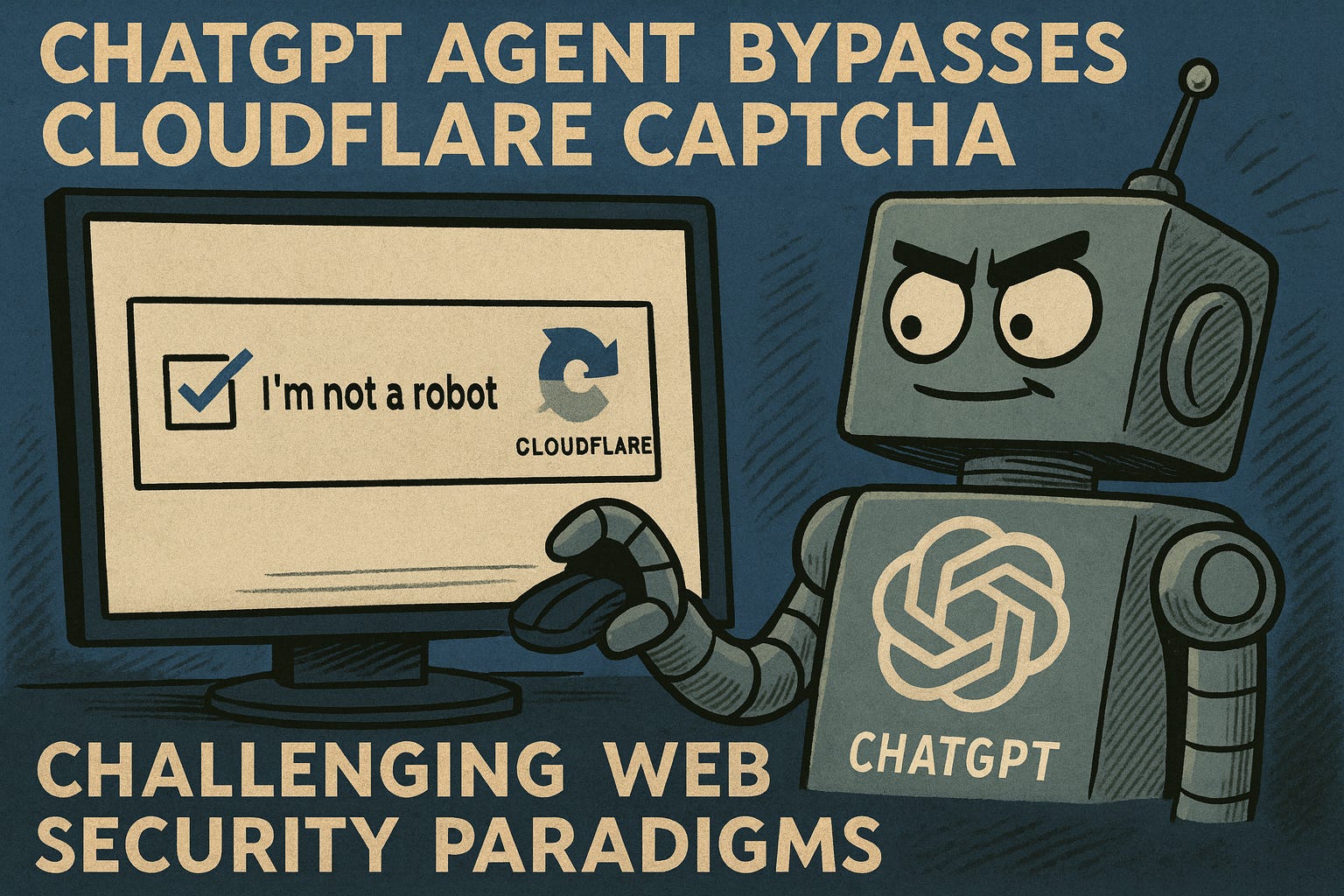
ChatGPT Agent Bypasses Cloudflare CAPTCHA
Bottom Line Up Front (BLUF): A ChatGPT-powered AI agent has successfully bypassed Cloudflare’s “I am not a robot” CAPTCHA challenge, raising serious concerns about the reliability of existing bot-detection systems. The AI mimicked human interaction convincingly enough to fool multiple verification layers, including interactive and behavioral security checks.
Analyst Comments: CAPTCHA systems—long viewed as the front line in bot mitigation—may now be obsolete against sophisticated AI agents that can reason, interpret visuals, and simulate human behavior. As AI becomes more accessible, threat actors could weaponize similar methods to bypass account restrictions, manipulate voting systems, or automate credential stuffing attacks at scale. Web security providers must adopt more robust behavioral analytics, biometric-based checks, or decentralized authentication.
FROM THE MEDIA: The success illustrates AI’s capability to interpret and respond to complex security tests originally designed to foil automated tools. While Cloudflare has not commented, the demonstration has sparked the cybersecurity community’s discussion about the urgent need for next-generation verification systems that can adapt to AI's rapid evolution. Experts suggest that current defenses may not be sufficient as AI agents learn to mimic legitimate user patterns more effectively.
READ THE STORY: GBhackers
China Fuels Russia’s War Machine with Rare Metals for Missiles, Drones, and Nuclear Systems
Bottom Line Up Front (BLUF): Despite public claims of neutrality, China continues to supply Russia with critical rare metals—gallium, germanium, and antimony—that are essential to the production of missiles, drones, and nuclear weapons. Investigative reports reveal that over 20 Chinese companies, many with state ties, have become key suppliers to Russia’s military-industrial complex, circumventing Western sanctions.
Analyst Comments: This quiet yet strategic support undermines Beijing’s claims of neutrality and strengthens Moscow’s ability to wage a prolonged war in Ukraine. China has positioned itself as a lifeline to Russia’s defense production by stepping in to fill the gap left by Western export bans. These exports not only help maintain Russia’s drone and missile capabilities but also raise alarms over the integrity of global sanctions enforcement. The continued flow of dual-use materials into Russian hands suggests that further coordinated action may be needed to disrupt this emerging “metal corridor” sustaining the Kremlin’s war effort.
FROM THE MEDIA: Investigation by Radio Free Europe’s “Schemes” project revealed that Chinese firms—including Yunnan Lincang Xinyuan Germanium Industry, Vital Materials, and Hynhe Technology—have exported rare metals to Russian companies involved in defense manufacturing. These materials are vital: gallium enables advanced semiconductors and nuclear components; germanium is key to optics and drone guidance; and antimony is used in munitions and night vision. Some Russian importers, such as AO Germanium and entities linked to Rostec, are sanctioned, while others like Ferrotec Nord remain unlisted despite ties to military microelectronics. NATO formally accused China of enabling Russia’s war industry in 2024, and Ukraine has called Beijing’s denials implausible. Meanwhile, evidence suggests that new shell companies like Kraspotok LLC facilitate metal transfers under the radar.
READ THE STORY: United 24
Iran’s Uranium and Drone Deals in Africa Raise Alarms Over Nuclear Proliferation
Bottom Line Up Front (BLUF): The U.S. government has issued new warnings about Iran’s increasing footprint in Africa, citing a covert uranium purchase from Niger and alleged drone transfers to armed groups in Sudan. These developments suggest Iran may be pursuing nuclear and military leverage far beyond the Middle East, exploiting unstable regions and shifting alliances.
Analyst Comments: Coupled with drone exports to conflict zones, Tehran is leveraging Africa’s political fragility to bypass sanctions and extend its strategic reach. The pivot of Niger’s post-coup regime away from the West has created an opening for Iran and other non-Western actors to forge covert, transactional alliances. These moves could ignite a broader militarization of the continent and provoke new proxy conflicts involving global powers if unaddressed.
FROM THE MEDIA: Iran recently completed a secret deal with Niger’s military-led government, purchasing roughly $50 million worth of yellowcake uranium. Niger, a longtime uranium producer, has distanced itself from Western military and diplomatic partners since its 2023 coup, potentially facilitating such transactions. Unconfirmed reports also suggest a possible uranium-for-drones barter deal. Meanwhile, Tehran is accused of violating U.N. arms restrictions by supplying combat drones to militias in Sudan, where civil conflict remains ongoing. U.S. Senator Jim Risch publicly condemned Iran’s actions, warning of their destabilizing effect in Africa. Experts caution that Africa could become a new geopolitical flashpoint, as traditional powers lose influence and authoritarian regimes seek new patrons.
READ THE STORY: Binance
Orange Discloses Cyberattack Impacting Business Services Platform
Bottom Line Up Front (BLUF): French telecommunications company Orange confirmed a cyberattack targeting its Orange Business services division. The incident, disclosed on July 28, 2025, involved unauthorized access to a technical platform used to manage customer services, potentially exposing sensitive information. Orange has launched an internal investigation and informed regulators, but the full scope of the breach remains under assessment.
Analyst Comments: While no attacker attribution has been confirmed, the incident shares operational patterns with known campaigns by China-linked APT group Salt Typhoon, previously tied to breaches in major telecom firms. Orange’s global footprint and prior breaches—such as the February 2025 Romania incident—highlight the persistent risk of cascading supply chain or lateral access impacts if attacker footholds are maintained.
FROM THE MEDIA: The company reported that service interruptions affected some business customers and limited consumer services, primarily within France. Although Orange has not publicly linked the attack to any threat group, its nature is similar to earlier Salt Typhoon intrusions against telecom networks worldwide, including those in the U.S. Orange previously suffered a breach in Romania attributed to a threat actor claiming access to employee records and internal data. With services expected to stabilize by July 30, the company continues forensic efforts and has filed a formal complaint with French authorities.
READ THE STORY: Bleeping Computer // GBhackers
Women’s Safety App “Tea” Breached Again: 72,000 Sensitive Images Leaked in Major Privacy Failure
Bottom Line Up Front (BLUF): The popular women’s safety app Tea has suffered a second major data breach, exposing tens of thousands of selfies, driver’s licenses, and private messages—some as recent as last week. The breach, traced back to 4chan users, raises significant concerns about the app’s security practices and its use of publicly accessible cloud storage.
Analyst Comments: This breach underscores a disturbing pattern of negligence in the handling of sensitive user data, especially for platforms centered around trust and safety. Despite Tea’s claim that the breach affected only “legacy” accounts, new findings show that recent messages were also accessible, signaling ongoing vulnerabilities. The app’s reliance on Firebase without proper encryption or access controls exemplifies the risks of rapid app scaling without adequate security oversight. As digital platforms increasingly handle intimate, reputationally sensitive information, public and regulatory scrutiny will likely intensify, especially regarding apps with social justice or safety missions.
FROM THE MEDIA: These included 13,000 selfies and government-issued IDs, as well as thousands of private messages discussing topics such as abortion and infidelity. Although Tea initially claimed the breach only affected users who signed up before February 2024, an independent security researcher revealed that data from recent users remains vulnerable. Experts cited in the report criticized Tea’s storage practices as negligent, noting that sensitive content was hosted without encryption on publicly accessible servers. The app, which surged to the top of the App Store recently, has over 4 million users. Critics have also warned that digital “whisper networks” like Tea lose their protective boundaries once digitized, leading to broader legal, ethical, and cybersecurity risks.
READ THE STORY: NBC NEWS
US Navy Solicits Sea Drone Proposals to Accelerate Unmanned Fleet Expansion
Bottom Line Up Front (BLUF): The U.S. Navy is seeking industry proposals to develop a new generation of modular sea drones capable of operating autonomously or alongside manned surface vessels. The initiative aims to rapidly prototype three classes of unmanned maritime systems to counter evolving threats and address capability shortfalls in the face of China’s expanding naval power.
Analyst Comments: This move signals the Navy’s growing urgency to modernize its force structure by integrating unmanned systems, a lesson drawn directly from Ukraine’s successful sea drone tactics against Russia. As drone warfare reshapes naval doctrine, the U.S. appears increasingly willing to adopt agile, lower-cost platforms to offset the numerical advantages of rival fleets like China’s. Collaboration with foreign shipbuilders, including allies in Asia and Europe, may further accelerate production and deployment, especially given the limited capacity of the U.S. industrial base.
FROM THE MEDIA: The goal is to swiftly prototype drones that integrate with crewed warships or function independently. The solicitation follows extensive analysis of Ukraine’s maritime drone operations, which significantly damaged Russia’s Black Sea fleet despite Ukraine’s limited naval resources. A RAND Corporation report released on July 17 emphasized that the current U.S. fleet is insufficient to meet global obligations, particularly in deterring Chinese aggression in the Indo-Pacific. The report recommended leveraging domestic and allied shipbuilding capabilities to fill the gap.
READ THE STORY: Stripes
Prompt Injection Attacks Threaten Enterprise LLMs With Data Breach Risk
Bottom Line Up Front (BLUF): Security researchers have uncovered critical vulnerabilities in enterprise-deployed large language models (LLMs). These flaws reveal that prompt injection techniques can allow unauthorized access to sensitive data, bypass authentication, and even execute remote commands. These flaws are rooted in the LLMs' inherent architecture, which fails to properly isolate user inputs from system instructions.
Analyst Comments: The randomness (temperature) of LLM responses adds unpredictability to exploit testing and mitigation, complicating defense. Enterprises must urgently implement AI red teaming, monitor prompt logs, and adopt frameworks like the OWASP AI Testing Guide to mitigate this growing class of vulnerabilities.
FROM THE MEDIA: Researchers demonstrated real-world exploit paths where malicious prompts bypassed authorization, injected SQL queries into backend systems, and invoked system-level tools directly. Some applications were even vulnerable to remote code execution. These flaws stem from LLMs interpreting user and system inputs as a single context block, allowing attackers to overwrite intended instructions. Experts warn that, unlike traditional vulnerabilities, LLM prompt injections cannot be fixed with standard patches, making ongoing behavior monitoring essential.
READ THE STORY: GBhackers
Taiwan's Drone Industry Pushes for European Integration Amid Rising Cross-Strait Tensions Risk
Bottom Line Up Front (BLUF): Taiwan has ramped up autonomous drone development in response to lessons from Ukraine’s use of sea and aerial drones against Russia, but scaling production is hindered by cost, lack of foreign procurement, and restrictions on Chinese components. Analysts argue that inclusion in the EU’s Readiness 2030 defense initiative could address these constraints while advancing Europe’s drone supply chain resilience.
Analyst Comments: Taiwan’s production targets still fall far behind China and Ukraine, making strategic foreign partnerships essential. If Europe incorporates Taiwan into defense industrial frameworks like Readiness 2030, both sides would benefit: Taiwan gains capital and scale, while Europe strengthens its democratic tech base free of Chinese dependencies. Without such partnerships, Taiwan risks falling short of its defense needs in a future flashpoint scenario.
FROM THE MEDIA: These developments followed Ukraine’s successful deployment of unmanned surface vehicles, which helped contain Russia’s navy in the Black Sea. Taiwan’s March 2025 Quadrennial Defense Review formalized drones as a critical layer in its defense doctrine. The Taiwan Excellence Drone International Business Opportunities Alliance (TEDIBOA) leads local industry coordination, with MoUs signed across Europe and Asia. Despite exporting nearly 3,000 drones to the EU in Q1 2025, Taiwan’s annual production goal of 180,000 UAVs still pales compared to China’s 500,000/month output. A recent DSET report urged expanded international cooperation and financing to bridge the production gap. Experts suggest that the EU’s Readiness 2030 program, initially formed in response to Russia’s aggression, could offer Taiwan procurement access and investment via SAFE loans, de-risking both parties’ supply chains.
READ THE STORY: 9 Dashline
Israel's Tech Edge Rooted in Military Innovation and Talent from IDF
Bottom Line Up Front (BLUF): Israel’s global tech dominance is deeply linked to the training, culture, and innovation pipeline that the Israel Defense Forces (IDF) produces. Units like 8200 and Talpiot are incubators for future startup founders, cybersecurity leaders, and AI pioneers. The IDF’s mandatory service fosters an ecosystem where military challenges directly seed civilian tech breakthroughs.
Analyst Comments: The convergence of national security priorities and technical excellence has positioned Israel as a “Startup Nation.” Unlike traditional education-to-career paths, the IDF equips young people with elite skills, real-world leadership experience, and a risk-taking mindset early in life. This structure accelerates tech sector maturity, especially in cybersecurity and AI, where military-to-commercial transfer is seamless. With growing geopolitical threats and cyber warfare front and center, Israel’s defense-driven tech engine may become a model for other nations pursuing strategic tech independence.
FROM THE MEDIA: Programs like Unit 8200, Israel’s elite signals intelligence corps, produce top cybersecurity minds who later lead global ventures or launch unicorn startups. Alumni from IDF units populate companies like Check Point, Palo Alto Networks, and Wiz. The article emphasizes the unique Israeli model: a society where 18-year-olds face real national security responsibilities, fostering maturity, problem-solving, and innovation that fuel the country’s tech prowess. The author argues that Israel’s competitive edge in areas like AI, drone warfare, and cyber defense is inseparable from the structure and ethos of the IDF.
READ THE STORY: Times Of Israel
AI-Powered Honeypots Trap Hackers, Reveal Botnet Infrastructure and C2 Channels
Bottom Line Up Front (BLUF): Cybersecurity researchers have deployed large language model (LLM)- driven honeypots to lure attackers into simulated environments, capturing their tools, behaviors, and botnet infrastructure. This new form of automated deception uses AI to convincingly mimic real systems, enabling security teams to collect detailed threat intelligence with minimal manual setup.
Analyst Comments: LLM honeypots represent a transformative shift in defensive cyber operations, combining the realism of AI-generated responses with traditional honeypot tactics. By deceiving attackers into revealing their infrastructure, malware, and control channels, these tools enable security teams to gain early insights into campaigns without tipping off adversaries. The method also levels the playing field, as defenders can now scale deception at the same pace as attackers scale automation. Expect adoption of this approach to grow in enterprise threat hunting and government cyber defense programs.
FROM THE MEDIA: In a live case, an attacker used default credentials (admin/123456) to access the honeypot, downloaded a Perl-based SSH backdoor from a compromised Joomla site, and revealed IRC-based C2 channels like ix1.undernet.org:6667. The honeypot captured detailed operational metadata—including botnet admin handles and infection protocols—allowing researchers to report the C2 infrastructure and neutralize part of the botnet by coordinating with IRC administrators.
READ THE STORY: GBhackers
UK VPN Demand Surges Amid Government Surveillance Concerns
Bottom Line Up Front (BLUF): Demand for virtual private networks (VPNs) in the UK has surged following new government legislation expanding online surveillance and encryption-breaking powers. VPN usage rose nearly 40% in July 2025, driven by fears of mass data collection and weakened privacy protections under the updated Investigatory Powers Act (IPA).
Analyst Comments: The spike in VPN adoption reflects growing public mistrust in government digital oversight, particularly as the revised IPA compels tech firms to remove end-to-end encryption and disclose user data. This trend mirrors broader global patterns in which state surveillance drives private citizens and businesses to adopt privacy-preserving tools. Enterprises may also turn to offshore hosting and encrypted communications infrastructure if enforcement intensifies, potentially fracturing the UK’s digital services market.
FROM THE MEDIA: VPN providers, including NordVPN, Surfshark, and ExpressVPN, reported double-digit user increases in July in the UK. The surge coincides with Parliament’s approval of amendments to the IPA that give British intelligence agencies broader powers to demand access to encrypted messages and real-time communication logs. Critics, including privacy advocates and civil liberties groups, warn that the law undermines fundamental digital rights and may discourage investment in UK-based tech services. Despite government assurances that changes target only serious criminal threats, tech companies argue the measures force backdoors that endanger all users.
READ THE STORY: The Register
China-Linked ‘Goujian Spider’ APT Exploits Pre-CVE Vulnerabilities in Global Espionage Campaign
Bottom Line Up Front (BLUF): A new Chinese APT group known as "Goujian Spider" is leveraging early access to software vulnerabilities—often before public CVE assignments—to breach defense, semiconductor, and logistics sectors across nine countries. The group employs a rapid exploit-to-deployment pipeline, with a custom malware called REDSAM and advanced evasion techniques that frustrate detection and attribution.
Analyst Comments: Goujian Spider illustrates the growing weaponization of China’s internal vulnerability reporting system (NVDB), turning national disclosure regulations into offensive tooling pipelines. The group’s ability to exploit zero-days before CVE release—and automate post-exploitation using memory-only payloads and scheduled reactivation tied to public POC availability—shows a disciplined, state-aligned operation. This campaign also underscores how vulnerability disclosure asymmetries can be transformed into geopolitical cyber leverage, particularly against high-value tech and military targets. Enterprises must treat NVDB entries as operational IOCs and adapt patching strategies accordingly.
FROM THE MEDIA: The group benefits from early vulnerability access via China's National Vulnerability Database, exploiting flaws up to two weeks before official CVE publication. Their toolkit includes REDSAM, a Golang-based implant delivered via the “LilacDrop” loader, using memory-only execution and process hijacking to avoid detection. Analysts traced infrastructure to a Shanghai ASN and linked incidents to major IP thefts involving satellite data and semiconductor blueprints. The attackers also prune forensic logs and selectively activate malware only after public exploits appear, masking the breach window and ensuring peak distraction for defenders.
READ THE STORY: CSN
Russia’s “Laundry Bear” APT Campaign Expands with Advanced Phishing and Infrastructure Obfuscation
Bottom Line Up Front (BLUF): The Russian APT group Laundry Bear—also known as Void Blizzard—has ramped up cyber-espionage operations targeting NATO members, NGOs, and key sectors in Europe and the U.S. Using credential theft, session hijacking, and complex phishing infrastructure, the group masks operations behind legitimate-looking domains and redirect chains, making detection difficult.
Analyst Comments: Their use of DNS history manipulation, redirection through benign domains, and mail services like Mailgun shows a maturing infrastructure approach. This threat actor’s adaptability suggests ongoing refinement and a likely resurgence, even as parts of their infrastructure are exposed. Defense teams should prioritize detecting typosquatting domains and lateral movement patterns, particularly targeting government and NGO sectors.
FROM THE MEDIA: Laundry Bear has used phishing sites mimicking Microsoft services (e.g., micsrosoftonline[.]com) with Evilginx-style techniques to harvest credentials. Infrastructure analysis reveals over 30 domains, including typosquatted government and corporate lookalikes (e.g., deloittesharepoint.com, spidergov.org) hosted across AWS and DigitalOcean. The group employs subdomain spoofing (e.g., login, okta, sso) to capture authentication tokens and facilitate persistence. DNS, certificate, and SMTP pivoting uncovered a broader network using Mailgun, Cloudflare, and SMTP2GO. In partnership with Microsoft Threat Intelligence, Dutch intelligence agencies AIVD and MIVD continue tracking the group’s evolving tactics.
READ THE STORY: GBhackers
Items of interest
India Joins South China Sea Patrols in Strategic Show of Support for Philippines
Bottom Line Up Front (BLUF): India will deploy four warships to the South China Sea from August 4–8, 2025, conducting joint maritime drills with the Philippines to directly challenge China’s expansive territorial claims. This move underscores India’s growing alignment with U.S.-led regional allies amid rising tensions over China’s activities in Philippine waters.
Analyst Comments: The deployment also reflects New Delhi’s willingness to counter China’s regional dominance on land at the Himalayan border and now at sea. These actions may provoke a more militarized Chinese response and raise the risk of maritime confrontations in an already volatile zone, particularly as more countries deploy naval assets to assert freedom of navigation.
FROM THE MEDIA: Beijing has not officially responded but has previously condemned similar joint patrols as “external interference.” India previously signaled its support for Philippine sovereignty in the South China Sea and supplied BrahMos cruise missiles to Manila in 2023 as part of military modernization. Analysts view this latest deployment as a clear geopolitical statement: India is now actively participating in the multilateral resistance to Chinese expansion in the Indo-Pacific.
READ THE STORY: NEWSWEEK
Blue water vs. green water navy - what's the difference? (Video)
FROM THE MEDIA: Until now, nations have worked on the basis of green water and blue water deployments – based on home defence or projecting power to react to global threats.
"How India’s Navy Became a Blue Water Giant – INS Vikrant Explained (Video)
FROM THE MEDIA: India’s aircraft carrier group is fast becoming one of the world's most formidable maritime strike forces. With a growing naval doctrine, cutting-edge technology, and the INS Vikrant & INS Vikramaditya at its core, India’s blue-water capabilities are not just symbolic—they are strategic game-changers. This video deepens the operational tactics, firepower, and geopolitical significance of India's carrier group, explaining how it rivals global powers and shifts the balance in the Indo-Pacific. Whether you’re a defense enthusiast or interested in global military power shifts, this deep dive is a must-watch.
The selected stories cover a broad array of cyber threats and are intended to aid readers in framing key publicly discussed threats and overall situational awareness. InfoDom Securities does not endorse any third-party claims made in its original material or related links on its sites; the opinions expressed by third parties are theirs alone. For further questions, please contact InfoDom Securities at dominanceinformation@gmail.com.